A TEMPORARY reduced speed limit is now in force along a section of Birchip-Dumosa Road, following an accident on Monday.
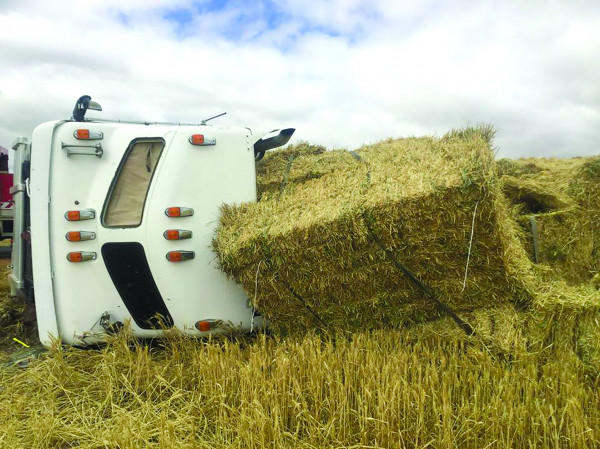
Police attended about 9.30am on Monday after a Kenworth prime mover B-double carrying a load of hay rolled on a bend near Dumosa.
Police said the driver was trapped for a short period of time, but escaped unharmed.
Heavy haulage attended and towed the truck and trailers away.
Police also took the opportunity to speak to local farmers about their concerns with the section of the road, and immediately engaged Buloke Shire Council.
Council has since put up temporary speed signs, reducing the section of road to 80km/h.
Police have appealed to drivers to be patient and adhere to the new limit.
Council has met with VicRoads to discuss a more permanent solution, but in the meantime have also asked drivers to adhere to the temporary speed limit and take care on local roads.
Buloke Shire Council director works and technical services Wayne O’Toole said speed reduction was introduced following a request from Victoria Police to assist with traffic management of the clean-up and removal of the damaged truck and large load of hay bales on the north side of Birchip-Dumosa Road.
“Speed reduction is in place for safe traffic movements while there is still loose hay and debris on the north side of the Birchip-Dumosa Road following the truck incident site,” Mr O’Toole said.
“Once council is made aware of a traffic incident of this kind, council will inspect the site and may or may not change advisory signage and advisory speeds signage.
“Council liaise with VicRoads (Rural Roads Victoria) before adding or changing speed signage in any location.
“No road repair is required in the area following the truck incident.”
Mr O’Toole said council had not previously been made aware of any issues with the road.
“The traveling public are advised to drive in a safe manner at all times and to the conditions of any roadway, taking into account road conditions, traffic conditions and the prevailing weather conditions at all times,” Mr O’Toole said.