SWAN Hill Rural City Council is committed to a working drag strip in the municipality but “not at any cost”.
At this week’s council meeting, council resolved to investigate the cost of undertaking a geotechnical investigation of the Chisholm Reserve track, which has been plagued by issues since it became operational in 2016.
The initial construction and ongoing repair work has cost ratepayers more than $1 million over the past three years, and mayor Bill Moar said he was aware of waning public support for further maintenance.
The most recent unbudgeted allocation of $170,000 was committed to ensure the track was fit to host the 2019 Garrett Melbourne Jamboree racing event, expected to attract between 250 and 300 cars.
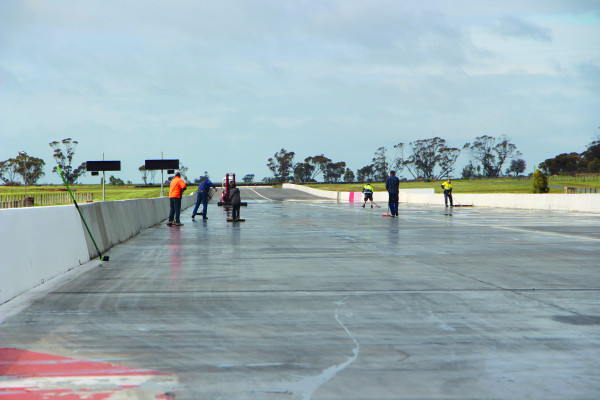
Despite grinding and maintenance works being completed on the track, however, the event was cancelled in November due to the track continuing to show movement.
Mr McLinden said while at the completion of works the track was reported by the club to be in excellent condition, two weeks later an area of asphalt very close to the 1000-foot mark has sunk by 15mm to 20mm, while at the 330-foot mark, a slab of concrete had heaved up and cracked in the middle.
“The racing surface of the Swan Hill drag racing strip continues to develop problems, causing unevenness to the surface,” Mr McLinden said.
“This roughness renders the strip unsuitable for racing and has required council to invest additional funds into repairs and maintenance of the strip.”
Mr McLinden said the exact cause of unevenness at the strip was hard to identify without proper investigation, but it was suspected the instability lie in the condition of the subgrade beneath the track.
“Without investigating the subgrade, it is not possible at this point to definitively explain the cause of these faults, but it is likely they are caused by thermal expansion of the concrete, coupled with the movement in the subgrade caused by the moisture variation resulting in swelling and sinking of the subgrade,” Mr McLinden said.
“With respect to the asphalt section, it is almost certainly the drying out of the subgrade leading to shrinkage of the subgrade and settlement surface.
“There is apparently footage of a car having difficulty traversing the 1000-foot mark at great speed and that this difficulty is apparently caused by the unevenness of the track which only three weeks earlier was in excellent condition.”
Mr McLinden told The Guardian changes made to construction following the initial design of the track had been “unwise”.
“One of the concreters that tendered for the work, and was successful, proposed an alternative method of how the concreting would be done and council accepted that proposal,” he said, adding no concerns were flagged about the change in method at the time.
“No (concerns), but they have been the cause of issues since, there is no doubt about that.
“I believe it was probably an unwise decision to go to a box method rather than a continuous spread of concrete.”
Cr Moar told The Guardian one of council’s key focusses was that the club stay together in the interim of any action, though the club has balked at suggestions it host 1/8 mile events due to insurance issues.
While the report brought before council this week proposed a “short-term way forward”, with six points of action, councillors instead resolved to investigate the cost of further action before committing.
Cr Les McPhee moved the motion after an amendment from Cr Chris Jeffery was put and lost to adopt the six points of action, adding the track be closed to 1/4 mile drag racing, but not to 1/8 mile events.
Included in the action plan was a recommendation council undertake a geotechnical investigation using left over funds from the $170,000 committed for maintenance in October.
“This drag strip, we need to figure out what is going on…I have concerns that money (leftover) is not enough to do a geotechnical survey,” Cr McPhee said.
“What we should be asking is how much is a geotechnical survey going to cost?