NEW South Wales and Victoria have declared a state of emergency as bushfires continue to burn in both states, forcing entire towns to evacuate.
Mallee firefighters and State Emergency Services (SES) Swan Hill unit members have joined strike teams to relieve fatigued volunteers on the ground, while military helicopters and ships have been deployed to assist in evacuations of towns hardest hit.
As of yesterday morning more than 150 fires continued to burn across NSW, while in Victoria fire has ravaged the East Gippsland region, with more than 110 homes lost.
More than 900,000 hectares have been burnt, forcing the evacuation of locals and holiday-makers.
At time of print yesterday authorities were working to confirm whether a fire at Corryong, in Victoria’s north-east, had merged with fires across the border in NSW.
A total 48 fires were still burning across Victoria, with two people confirmed dead and seven unaccounted for across fire-affected regions of NSW and Victoria.
NSW Premier Gladys Berejiklian declared a state of emergency for seven days from Friday, allowing authorities to forcibly evacuate people before the worsening fire conditions on Saturday.
It is the third state of emergency declared for NSW since November due to dangerous fire conditions.
A state of emergency declaration enables certain powers to be exercised by the Rural Fire Service Commissioner, these include; to direct any government agency to conduct or refrain from conducting its functions, control and coordinate the allocation of government resources, evacuate people from property within the declared area, close roads, order the shut down of essential utilities in the declared area and enter or take possession of property in the course of emergency response.
“Declaring this state of emergency is vital to the safety of communities in NSW as we face the most devastating bushfire season in living memory,” Ms Berejiklian said on Thursday.
Victoria followed suit late Thursday evening, with Premier Daniel Andrews declaring a state of disaster for six local government areas and the Alpine Resorts following advice from Minister for Police and Emergency Services Lisa Neville and the Emergency Management Commissioner Andrew Crisp, with conditions expected to deteriorate from Friday.
These areas included the East Gippsland, Mansfield, Wellington, Wangaratta Rural, Alpine and Towong shires, in addition to Mount Butler and Mount Hotham.
This was the first time the Victorian Government had used these powers since they were included in the Emergency Management Act following the devastating 2009 bushfires.
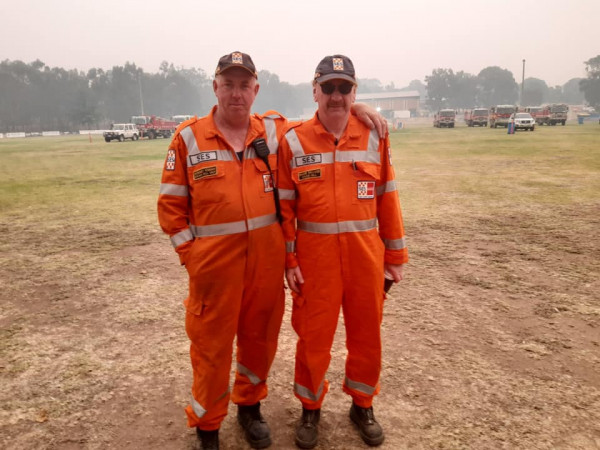
Swan Hill SES unit volunteers Shane Bavage and Rod Knight have joined a team from the north west, travelling to Victorian town Corryong on Thursday.
An evacuation alert was issued to the town’s residents that evening.
Swan Hill SES unit controller Darren Barnes said the volunteers would act in a support role to fire agencies, doing “anything that needs to be done”.
“At the moment it is just two from each unit in the north west, they were deployed yesterday and will return on Tuesday,” Mr Barnes said.
“It’s a day’s travel each way and the rest of the rime they’re either on for a daylight shift or a night-time shift.
“They will be taking on multiple different roles, that includes staking and area management, relocation of residents, transporting of food and water supplies to the CFA and DELWP and basically anything else that needs to be done.”
Mr Barnes said now in the fire zone, contact with the local members was not easily accessible.
“We haven’t had any contact with them since they got to Corryong, there are no phone systems there, all the towers have been burnt around that area,” he said.
Mr Barnes said the unit had previously had a member go into the incident control centre on a “couple of occasions”, while two other locals are set to join the RFS unit setting up vital communication means.
“Terry Ashworth will be going over the with RFSU, they set up communication towers so that our radio systems work in that area, all of the infrastructure in the fire zone is gone, he’s going over with Keith Blackman,” Mr Barnes said, adding he urged locals to rally behind fundraising efforts in support of bushfire victims.
“The community support with the Red Cross with the donation of clothing for people who have lost everything would be great and if they could get behind any fundraising things for the fires they can support people that way as well,” he said.
Mallee CFA volunteers were also deployed on Thursday morning, with a team having returned after battling fires in East Gippsland over New Year’s.
An additional 30 firefighters boarded busses to join the firefight yesterday, headed for Swifts Creek and Corryong.
BREAK OUT STORY: PAGE 2 PLEASE
NEARLY 50 CFA volunteers from the Mallee region have left to provide much-needed relief to exhausted firefighters battling bushfires in Victoria.
CFA District 18 operations manager John Bigham told The Guardian on Friday there were currently 18 volunteers from the district deployed, with another team deployed yesterday.
“A whole other bus load will be sent tomorrow (Saturday) with another 30 on board,” Mr Bigham said, adding volunteers were from right across the district including the Kerang, Murrayville, Swan hill and Ouyen brigades.
Volunteers will travel for one day, before spending another three at the fireground.
Mr Bigham said the district also had five people from the district 18 office working at the incident control centre in Bairnsdale, with more to be sent from the Swan Hill office to the Corryong incident control centre this week.
“From here on out our firefighters will be deployed to Swifts Creek and Corrying for a five day rotation and that is expected to happen for at least another month,” Mr Bigham said.
Weather conditions on Saturday created horrific conditions for firefighters, with high winds in the Alpine area, ahead of this Mr Bigham noted the worst outcome would be a merging of the Corryong fire and those burning in NSW.
He added despite cool conditions yesterday, relief would be limited.
Mr Bigham said it was “an unprecedented start to the fire season”.
“It will take some time for these fires to be brought under control,” Mr Bigham said.
“We ask the people in the Mallee to continue to take care.
“We haven’t depleted our firefighting force in and Mallee and can respond to incidents.”
Mr Bigham praised public behaviour and fire prevention efforts in the Mallee this fire season so far.
We thank the public for their fire prevention plans this year, we have seen their effectiveness demonstrated, with no major fires yet this year through the district,” he said.