KORALEIGH’S Stephen Hayes is among the unconquered veterans to feature in a new book on the Invictus Games, celebrating the courage and resilience of men and women wounded in action.
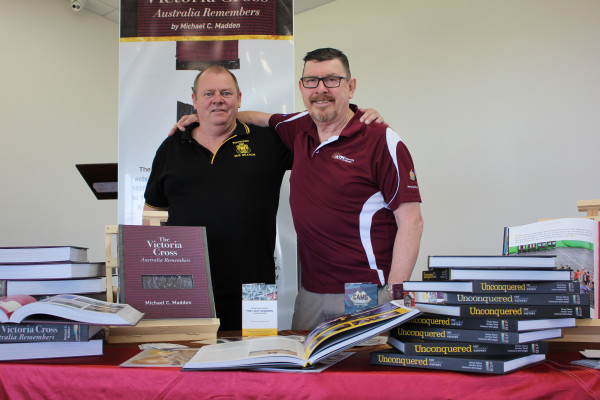
Co-author and photographer of Unconquered, Gordon Traill, visited the Woorinen RSL sub-branch last Wednesday, putting his recently published work on display, alongside his first; Victoria Cross, Australia Remembers, for which Mr Traill lended his talents as a photographer.
A defence force veteran himself, Mr Traill was medically discharged with more than 28 years in uniform and said, like the Invictus Games for many of the athletes, it was finding his passion for photography which ultimately drew him out from the black hole he had found himself in mentally.
Mr Traill said this experience was vital to his ability to connect with the men and women he interviewed for both books.
Photography started out as a hobby while he was on deployment in Iraq, as a way to share his experience and to describe the environment in a way words could not, but Mr Traill said he put the camera away when he returned, and it was only at a suggestion from his wife that he picked it back up.
“I joined the army, I was in the army for 28 years and then I got out just before East Timor started,” Mr Traill said.
“I’d just gotten out, that erupted, and then I wanted to go straight back in, but I didn’t, and then September 11 happened.
“That changed my life, I saw it and I was back in uniform in six weeks, it had a really profound effect on me, and then I went to Iraq in 2004.
“That’s when I bought my very first camera, a little point and shoot Nikon, I wanted to capture what it was like over there, some of the soldiers, the environment.”
Mr Traill said after he was medically discharged, he found himself at loose ends, struggling without the sense of belonging the armed forces provided.
“I didn’t know what to do,” he said.
“I lost my job, I lost everything — you lose your identity, because you’re a soldier and then suddenly you’re out of their system and you’re alone basically.”
Diagnosed with Post Traumatic Stress Disorder (PTSD) and with a serious neck injury which resulted in a stainless steel cage in his neck, Mr Traill said he “basically didn’t do anything” until about 10 years ago.
“My wife told me to get out and get a hobby — just to get out of the house and get a hobby, and she goes ‘Oh, why don’t you take up photography’,” he said.
“About 12 months ago, she said to me, ‘What I really wanted to say, was I wanted you to find something you were passionate about’.”
Mr Traill said he received plenty of support from his family as he honed his talents as a photographer, with his four children at once his “best supporters and harshest critics”.
“They were quite savage at times and other times they’d go, oh you’ve got something there dad, so that encouraged me to continue on,” he said.
Entering a couple of veteran story, art and writing competitions run by Veteran Affairs, Mr Traill was noticed by TPI Victoria (Totally and Permanently Incapacitated Ex-Service Men and Women’s Association of Victoria) executive officer Michael Williams.
“Michael rang me and said how would you like to come in, I have a proposition for you,” Mr Traill said, adding he went in, unsure of where this was headed, and was asked to do the photography for Victoria Cross Australia Remembers.
“So the journey started, and I thought ‘Oh yeah, I’ll just go around Victoria taking a few shots here and there’, but it led me to travel the world with Michael Madden, the author,” he said.
“Him and I, we went to the far flung places of the world, but we’re on charity money, which is TPI money, so we weren’t there for a good time, we were there for a short time to do it, get what we needed.”
Mr Traill said all proceeds from the sale of both Victoria Cross Australia Remembers and Unconquered go back toward supporting veterans.
In addition to the book, Mr Traill is also now TPI Victoria vice-president, and has continued his work with the organisation.
Mr Traill said the Victoria Cross book was an 18-month effort, which ultimately helped him to find his feet again.
“That was an amazing journey, to go and speak to the families, because what we wanted to do was make the stories warm and how you do that is to speak to the families and get an idea of what effect it had on them, growing up with a family member who was VC recipient,” he said.
A Victoria Cross, created by Queen Victoria in 1856, is awarded for valour in the presence of the enemy, 100 hundred Australians have received the cross before Australia moved to its own system.
Mr Traill said following the completion of the book, he received a phone call asking him to be photographer and co-author for a book on the Invictus Games.
It would turn out to be a six-month project that put him in touch with Woorinen RSL president, Mr Hayes, who competed in archery last year.
Mr Hayes said he received a phone call from Mr Traill on his way to the hospital following a transient ischaemic attack (TIA — a stroke like attack that temporarily blocks blood to the brain). Keen to get the message out there to other veterans, that you can move forward, Mr Hayes agreed to feature.
“I know it helped me, you’re telling someone your story, you’re actually talking about it,” Mr Hayes said.
“It’s fantastic that other people can read it, they can get hold of a little bit more tangible an idea of what people are going through and the different ailments.”
Mr Traill said photographing the six-day event which is the Invictus Games made for a “hectic” few days, despite having brought his daughter, Melanie, in for help.
“After the first day, I came back to my room and I was gutted,” he said.
“I had never shot sports before or anything like that, but I pulled up my pants and said ‘Stop being a sook and get on with it’ — so I did.”
Mr Traill said he and Melanie took around 6000 photographs over the six days.
“One of the things that this book has done is it highlights people with mental health or a serious injury issue, such as Gary Robinson, who lost his leg during the black hawk accident in Afghanistan, and like Stephen,” Mr Traill said.
“They had sport as an outlet and as a recovery tool, whereas I used photography and the arts as a healing tool.
“It gave me such purpose to do these two books in a two-year period.
“There’s not one story (that stands out from the rest) because each one of these stories needed to be told.”
Mr Traill said one of TPI’s aims was to get the books into as many schools as possible.
An effort Mr Hayes has already started locally, having purchased and gifted the book to six local schools earlier this year to allow them to run an education program.
Mr Traill said he found photography to be a powerful tool to help people understand the struggles and the enduring spirit of the veterans photographed.
He added it was also a way to help any veterans who may be struggling to see a way forward.
“If we can help even one veteran to get some help, then we’ve succeeded,” Mr Traill said.
“If you’re struggling, you can reach out to ex-service organisations such as TPI, the RSL, your mates that you served with.
“There is always someone who can point them in the right direction.”
Mr Traill said veteran suicides had now surpassed the initial deaths on the ground in Afghanistan.
“It’s over 300 veteran suicides since the start of Afghanistan to now, we lost 42 to the war, but we’ve lost over 300 returning from there,” Mr Traill said.
“We have to be aware of it. Everyone I know who is a veteran, I will always reach out to them and talk to them, ask ‘How are you really going?’, not ‘how are you going? Oh I’m good’, you have to drill down into it and say how are you really feeling? Do you need any help?.”
Mr Traill said the “ripple effect” of service also needed to be remembered.
“The ripple effect of your service is huge, it doesn’t just affect the male or female veterans…but definitely the ripple effect on family and also through the whole community, but if we can help one person, we’ve done our job,” he said.
“It’s an amazing journey, I didn’t have anything to look forward to, I couldn’t get out of bed, I just wanted to sleep all the time.
“Heavy medication, and through photography, it has allowed me to just go and lose myself during the day or night, depending on what I’m shooting.”
Mr Traill said he now terms his experience as ‘post traumatic growth’ rather than post traumatic stress, a way of thinking which has helped him to overcome some of his mental health struggles.
“If the paper goes to one veteran who might be sitting at home, not doing anything — and isolation is a killer, we have to get the message out that you can get help, it’s not all doom and gloom, you can get back to some sort of normality, but you have to work with health professionals on that as well,” he said.
His first time in the Mallee, Mr Traill said he was glad to make the trip to spread the word and meet with local RSL groups and ex-veterans.
Mr Hayes said it was good to see the book in the district, now in the hands of six local schools and on offer to the various RSL members present.
“It’s another fantastic thing that has come out of Invictus…lot of these people, if they didn’t go (to the games) they probably wouldn’t be here now, that’s the bottom line,” he said.
“What Gordon has been able to for us, by putting us in a book and getting our stories, letting us have a look at how he has portrayed us — it’s getting to see yourself in a different light.
“He’s put us down on paper and you think ‘Oh, that is me’, and that turns a lot of people around.
“You don’t talk to the wife, you don’t talk to the kids, but if another veteran comes in, you’ll both sit down because you can relate to what’s going on with each other.
“To me, if a guy’s feeling down and you pick up something like that and have a read through it, it’s just something that just may save your life.”
Copies of Victoria Cross, Australia Remembers and Unconquered can be purchased from TPI Victoria’s website at www.tpi.com.
If you need crisis support, call Lifeline on 13 11 14.