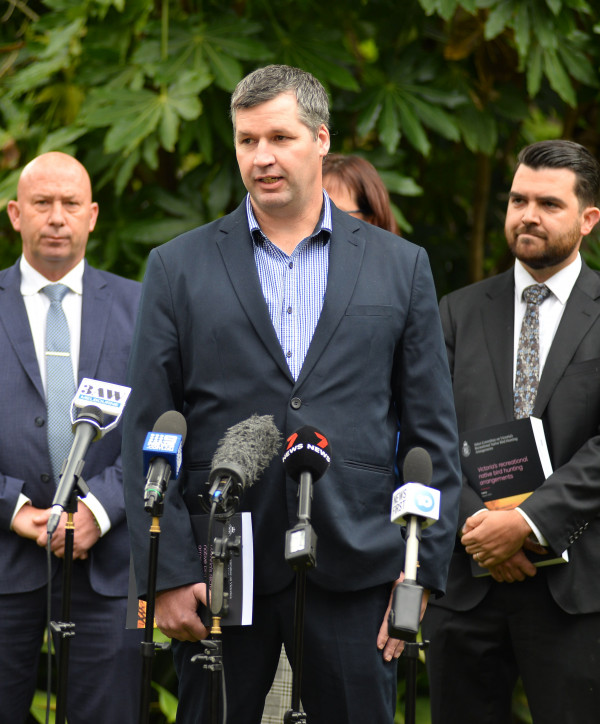
SHOTS have been fired from all sides of the duck-hunting debate after a proposal to end the recreational activity in Victoria.
A Legislative Council select committee probed the future of duck hunting for six months, reading submissions and listening to pro and anti-hunting groups and organisations at public hearings.
The committee ruffled feathers as it tabled the inquiry report into Victoria’s recreational native bird hunting arrangements in the Upper House on Thursday.
State Game Reserves would be opened up to the public for recreation activities such as camping and boating as part of the plan to outlaw duck hunting, from 2024.
Committee chair and Labor MP Ryan Batchelor said the rationale was driven by the “considerable environmental evidence of long-term decline in native bird populations, and a worsening outlook as our climate continues to change”.
“The committee was also acutely aware of the animal welfare issues associated with native bird hunting, as well as the amenity loss of large areas of public land to the overwhelming majority of the Victorian public during the hunting season.
“Tens of thousands of hectares of public land are off limits to non-hunters during duck season, but with the appropriate investment in infrastructure state game reserves could be converted into outdoor recreation reserves.”
The report makes further recommendations, including to retain traditional owner hunting rights and keep in place existing exemptions to hunt and control native bird populations impacting agricultural and other land.
Pro-hunting body Field & Game Australia said the recommendation was made “despite having heard compelling evidence in favour of the continuation of the recreational pursuit”.
Chief executive Lucas Cooke said the organisation was “deeply disappointed” the committee had chosen to heed concerns raised predominantly on the grounds of animal welfare.
“There is no logical reason to end duck hunting,” he said.
“Duck hunting is sustainable.
“While we respect and continuously address concerns related to animal welfare, it is important to note that imposing a ban on native game bird hunting would set a dangerous precedent.
“If they ban this on ideology alone, what else can they ban?
“Such a stance could potentially lead to bans on all hunting, fishing and even animal agriculture. The committee’s perspective, in our opinion, does not reflect the broader public interest.”
Nationals and Liberal members of the committee labelled the inquiry as a “stitch-up” and said they believed the outcome was predetermined.
“This inquiry is quite clearly a stitch-up,” Liberal Member for Northern Metropolitan Region Evan Mulholland said.
Member for Eastern Victoria Melina Bath was a member of the inquiry committee, which she described as “stacked” and “biased”.
“This inquiry was a missed opportunity to showcase the sustainability of hunting based on science and fact,” Ms Bath said.
Animal Justice Party MP and committee member Georgie Purcell said Victorians didn’t want to see native animals shot for a “thrill kill”.
“The recommendations by the select committee are common sense and in line with long-held community sentiment,” she said.
“It has been made abundantly clear through a parliamentary inquiry that no matter how well resourced the Game Management Authority is, monitoring duck shooter compliance is near impossible due to the enormous amount of places that shooting can take place.”
“Evidence from hunters, rescuers, animal-welfare groups and shooting organisations all acknowledged that duck shooting without wounding was simply not possible, and the committee has determined this an unacceptable animal-welfare outcome that can only be addressed with a ban.”
RSPCA Victoria welcomed the recommendation, with chief executive Dr Liz Walker saying “the high wounding rates for ducks and quail highlight the inherent and inevitable pain and suffering experienced by hundreds of thousands of ducks”.
Recreational duck shooting was outlawed in Western Australia in 1990, New South Wales in 1995 and Queensland in 2005.
The government said it would consider the report’s recommendations before making a final decision.