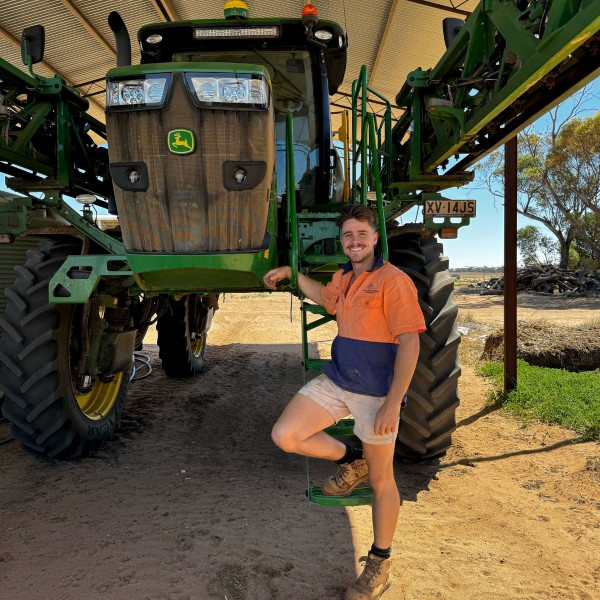
SOMEWHERE in the Mallee between Berriwillock and Culgoa, Will Simpson has been a headline sensation in The Guardian for the past two years as one of those farmers who’s been wanting a wife.
A challenge not for shrinking violets, as it was all done on national TV.
And his appearances on the show, his pairing with Jess Cova and trying to develop their relationship long-distance between Berriwillock and Queensland and most recently in the relative isolation of his family farm have all been devoured by fans of the show and those interested in how ‘reality TV’ works in the real world.
Well, one thing is for sure: while that all happens, the work on the Simpson farm doesn’t stop and, like most other farmers in north-west Victoria, Will has been hard at it on the sprayer getting ready for seeding.
But his journey to the seeder in March, to Farmer Wants a Wife and to a farming future has been a decidedly diverse ride.
From his final years at Tyrrell College in Sea Lake to his Bachelor of Social Welfare in Ballarat, it might have made farming a toss-up, but Will says he had his family behind him every step of the way.
“Fiona Best was my VCE ag teacher and a major contributor in my decision of studying a welfare degree,” Will saids.
“I worked in the welfare industry for a year before moving to Darwin and working in construction for seven months before travelling Australia for another three months before heading home in 2018.
“Permanently.”
The Simpsons farm two main areas: one between Berriwillock and Culgoa, and the other 15km west towards Willangie, comprising 2200ha of freehold and a further 500ha of share farmland.
Will is the fourth generation on the Berriwillock block where the family grows all the usual Mallee suspects: wheat, barley, lentils, canola, vetch hay and occasionally oats.
“We also run Merino ewes and cross them with Border Leicester rams to produce first-cross lambs – a process that has been a part of our farming enterprise for more than 40 years,” he said.
“I farm alongside my father Jamie and have in the past 12 months employed a full-time worker, Lachlan, which has played a pivotal part in our farm succession plan to allow Dad to begin decreasing his workload.
“Dad and I have a strong and respectful relationship which allows us to bounce ideas off each other daily and work through the generational changes in a sensible and conservative manner.
“I regularly rely on his years of experience and extensive knowledge while also incorporating my own ideas and research from Birchip Cropping Group and GRDC – and we work with agronomist Craig Muir from Agrivision.
“Throughout the busier periods, such as harvest, cropping and shearing, my mother Jenny also weighs in with the farm work, and Jess also enjoys regularly helping out around the farm and contributing to cropping, lambing, shearing and driving the chaser bin during harvest.”
While Will said the family was “extremely happy with how our harvest went” it wasn’t exactly a season of beer and skittles.
He said he believed one of the family’s biggest challenges for 2023 was having to take a less conservative approach with inputs to reach their potential yields, such as fertilisers at cropping, urea top-dressing, fungicide sprays and more spraying than there would have been historically.
Another challenge was looking past the doubtful long-term forecast early in the year and trusting that both farms had enough sub-soil moisture to get at least an average crop in a drier year.
Additionally, they dropped two paddocks of barley from a risk-management point of view, expecting the year to be drier than average.
Will said his long-term plan for the farm was to become more and more efficient every year by developing his knowledge and experience, upgrading machinery and equipment and adopting modern technologies.
He said he was looking forward to becoming more precise with cropping and optimising the farm’s potential each year.
“I believe this is achievable through personal development, as well as implementing the modern technologies that are available to us, such as using yield-mapping data for variable rate and new spray technologies and approaches, as well as being more paddock- and area-specific with inputs (rather than taking a blanket approach),” Will said.
He said he knew through BCG’s role as the northwest node of Vic Hub that the group was always looking at ways to prepare for drought as it was “an inevitable aspect of the climate we farm in”.
“We are extremely lucky to have had multiple good years in a row and I believe taking advantage of that position is crucial in drought-proofing our business,” he said.
“Upgrading machinery, equipment and farm infrastructure to improve efficiency while still striving for quality is an approach I believe will pay dividends in future, even in the drier years.
“Spreading our risk by running livestock is another approach we will continue.
“Providing flexibility to income by installing feedlot pens is one example of what we have done over the previous few years.
“Off-farm planning and investing is another option that we look at and discuss as a way to spread our financial risk.
“I believe flexibility in thinking and approaches to farming is one of the key aspects to being successful in the agriculture sector.”