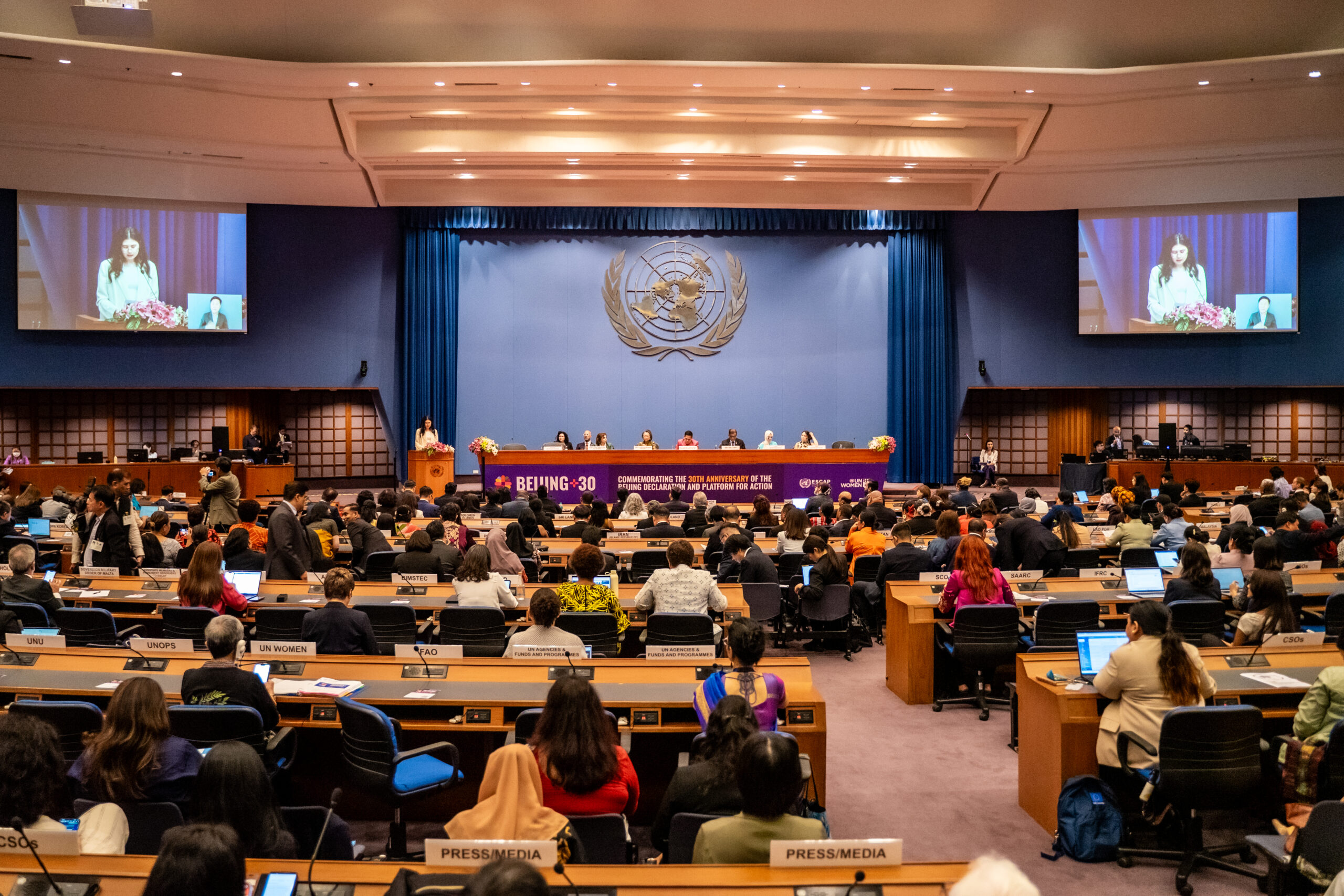
Three decades after the Fourth World Conference on Women in Beijing, the call for equality between men and women continues not as a distant hope, but as a living legacy. The work is unfinished, but the foundation is strong. As we prepare to celebrate the thirtieth year anniversary of the Beijing Conference, the world is remembering its commitments and recalibrating how to deliver them.
It began with a gathering unlike any before it: over 17,000 participants, 4,000 accredited NGOs, and a parallel forum drawing 30,000 more to Huairou near Beijing. In September 1995, governments, civil society, and activists co-signed a pact, the Beijing Declaration and Platform for Action, to deliver a detailed, practical, and global strategy for achieving women’s equality. It named the obstacles, laid out the plan, and committed the world to action. No prior global blueprint on women’s rights had been so specific, so endorsed, or so widely embraced.
Since then, the Beijing Declaration has echoed through national policies and global goals. It inspired 1,531 legal reforms improving conditions for women’s equality. Laws addressing domestic violence, once non-existent in most countries, now exist in nearly all. It similarly helped push women’s rights into the heart of the United Nations Sustainable Development Goals, not just as SDG5 but as a cross-cutting condition for progress across all development metrics. It remains the single most influential document shaping the international fight for women’s rights.
The Women, Peace and Security agenda, adopted by the United Nations Security Council in 2000, reinforced these commitments by recognizing women’s critical role in conflict prevention, resolution, and peacebuilding. This framework not only expanded the scope of women’s rights in fragile and conflict-affected settings but also strengthened pathways for implementing the Beijing Declaration. Since its adoption, a global network of organizations have begun to work within this agenda to integrate a Women, Peace and Security lens into policy and practice, including Our Secure Future, a US-based initiative advancing women’s meaningful participation as essential for building a more stable and prosperous world.
The Echoes of 1995
The changes set in motion by Beijing were real, measurable, and deeply structural. Maternal mortality dropped by roughly one-third worldwide. Parity between men and women in primary education was reached in many countries, and more girls attend school today than ever before. Legal recognition of women’s rights to property and inheritance has likewise gained ground in dozens of nations. The number of women in parliaments globally more than doubled from 11 percent in 1995 to 27 percent in 2025.
The Beijing Declaration was never meant to be static. But as the challenges have modernized and digitized, implementation has struggled to keep up. The rapid spread of generative artificial intelligence, as well as the rise of online harassment and surveillance have disproportionately targeted women in public life. A 2024 survey across Europe and Central Asia, for example, found that 53 percent of women had experienced some form of online violence.
Initiatives such as targeted digital skills training, mentorship programs for women in tech, and global efforts to increase female representation in AI leadership are helping to address some of these emergent challenges. Governments, companies, and civil society are collaborating to expand access to affordable internet and devices, particularly in underserved communities. Ensuring digital spaces are safe and accessible is now central to advancing the status of women. Strengthened policies, innovative reporting tools, and cross-sector partnerships are helping to curb online harms, making the digital world a powerful force for women’s empowerment rather than exclusion.
In addition, natural disasters have introduced new dimensions to global women’s rights efforts. These disasters often exacerbate existing inequalities, increasing risks of displacement, economic insecurity, and violence against women and girls. Altogether, these interconnected issues are underscoring the need for policy and action that integrates the perspectives of women and girls, who, especially in the Global South, face disproportionate risks, from food insecurity to displacement. Yet, they are also key agents of change. With meaningful participation in decision-making, they can drive effective adaptation and mitigation for a sustainable future.
Tracking Progress at CSW69
March 2025 marked the 69th session of the UN Commission on the Status of Women (CSW69), where the Beijing Declaration’s progress was formally reviewed. The moment also served as a reality check – only five years remain to meet the 2030 Agenda for Sustainable Development and realization of SDG5 on empowering all women and girls is behind schedule.
Out of that urgency came the Beijing+30 Action Agenda, six focused priorities designed to bridge the chasm between commitment and delivery. It calls for parity in decision-making, an end to violence in all its forms, closing the digital divide between men and women, and securing freedom from poverty. Women and girls in conflict zones are being re-prioritized in peace and security frameworks. The Action Agenda includes explicit calls to fully fund National Action Plans (NAPs) for Women, Peace and Security, as the number of countries with such plans rose from just 19 in 2010 to 113 today. Initiatives like Our Secure Future’s Women, Peace and Security NAP Academy are helping strengthen these efforts by providing resources and expertise to support the development and implementation of high-impact NAPs.
Declarations alone do not protect rights. Progress requires enforcement, funding, and monitoring mechanisms. The frameworks exist but without meaningful investment and implementation, they risk becoming symbolic. What is needed now is action that matches ambition. Governments must have the technical support needed to promote and fulfill their WPS mandates and local women’s groups must be resourced, included, and empowered to lead.
A Promise in Progress
Beijing+30 is not a final chapter, rather a turning point. The momentum built over the past thirty years is undeniable, even if challenges persist. The impact of structural inequality offline and now in the digital realm persists but so does the clarity of purpose that began in 1995. The story of Beijing has never been about perfection. It has always been about progress. Today, that progress lives in every girl who goes to school without fear, every woman elected to office, and every new law advancing women’s roles within society at its core. This anniversary is a commitment and a global reminder that equality is not just possible. It is essential, achievable, and already underway.
In the months ahead, Beijing+30 will be marked by high-level global gatherings that reaffirm this shared commitment, from the UN General Assembly’s 30th Anniversary High-Level Meeting on the Fourth World Conference on Women, to UN Women’s engagements at the 2025 High-Level Political Forum on Sustainable Development. These events will spotlight progress, mobilize new partnerships, and set the tone for the next decade of action for women’s rights and equality worldwide.
UN Women Executive Director Sima Bahous calls for unity of action over apathy in order to “ignite the spirit of the Beijing Declaration once again.” The world has the tools, frameworks, and examples. What remains is to match ambition with action and let the next chapter of the Beijing Declaration be written not in promises, but in power.